Chronic Pain Diagnosis Test: What Exists and What Each One Shows

If you have hurt for months and every result came back “normal,” you are not imagining it, and you are not out of options. Chronic pain is diagnosed through a layered workup: your history, an examination, targeted lab work and, when the picture points that way, imaging or nerve studies. For people whose pain comes with fatigue and no clear cause, the FM1® Test adds something most workups lack: a blood test that looks for DNA genomic signatures of immune system changes related to fibromyalgia, chronic pain and fatigue. It needs a simple blood draw, and results come back in about a week.
TL;DR
- Chronic pain means pain lasting longer than three months or beyond normal healing time, and no single scan or device measures it directly.
- A good workup combines your history, a physical and neurological exam, selected blood tests, and imaging or nerve tests when a cause is suspected.
- The FM1 Test is a DNA-based blood test designed to identify immune system changes related to fibromyalgia, chronic pain and fatigue.
- The FM1 Test is covered by Medicare and insurance, uses a quick blood draw at a local facility, and gives positive respondents access to a no-cost clinical trial.
- Bring a written pain timeline to your appointment: it shapes which tests get ordered.
Table of Contents
- What counts as chronic pain
- Why there is no single chronic pain test
- What a thorough assessment covers
- What blood tests can reveal
- When pain comes with fatigue
- Where the FM1 Test fits
- Chronic pain or fibromyalgia?
- Once you have answers
- Get tested with the FM1 Test
- Our perspective
- FAQ
- Sources
What counts as chronic pain
The National Institutes of Health describes chronic pain as pain that lasts longer than three months or beyond the time an injury should have healed. The National Institute of Neurological Disorders and Stroke uses the same three-month line and adds that pain is personal, so your own report is the best measure of it.
That second point is why so many patients feel dismissed. When pain is invisible on a scan, the conversation can drift toward “it’s stress” or “it’s just aging.” The way out is not to argue harder. It is to bring the right evidence into the room, and to ask for the tests that can produce it.
Why there is no single chronic pain test
The NIH states plainly that no single blood test, scan or device completely measures pain in another person. Pain is a symptom, and symptoms have many possible sources: nerves, joints, muscles, the immune system, hormones, infection, medications, sleep and mood, often several at once.
So clinicians do not look for “the pain test.” They look for the cause or causes. Each tool answers a different question:
| Tool | The question it answers |
|---|---|
| History and symptom timeline | When did it start, what makes it better or worse, how does it limit you? |
| Physical and neurological exam | Are there tender, weak or numb areas, or joint and nerve findings? |
| Blood tests | Is there inflammation, infection, a hormonal or nutritional problem, or autoimmune disease? |
| Imaging (X-ray, MRI, CT) | Is there structural damage in a joint, the spine or soft tissue? |
| Nerve tests (EMG, nerve conduction) | Is a nerve or muscle not working as it should? |
| Functional and quality-of-life questionnaires | How much is pain affecting sleep, work and daily life? |
| DNA-based immune testing (FM1 Test) | Are there genomic signatures of the immune changes tied to fibromyalgia, chronic pain and fatigue? |
The NIH lists physical and neurological examinations, laboratory tests, imaging, electrodiagnostic procedures, psychological assessments and functional assessments as the tools clinicians choose from, depending on what they suspect. HealthLink BC adds diagnostic nerve blocks to that list.
What a thorough assessment covers
A University of Michigan clinical guide, indexed by the National Library of Medicine, recommends that an initial evaluation document pain onset, time course, location, quality, intensity, functional impact, triggers and relievers, associated fatigue or cognitive symptoms, treatment history, medical and psychiatric history, medications, and family and social history. The same guide stresses function, quality of life, comorbid conditions, substance use, pain beliefs and psychosocial factors alongside examination findings and pertinent tests.
In practice, that means the visit is only as good as the information you bring. Our guide to what to expect from a chronic pain assessment and how to prepare walks through the visit step by step.
How to build your pain timeline
Before your appointment, write down:
- When it began and whether it followed an illness, injury, surgery or a stressful period.
- Where it hurts, including whether it moves or spreads.
- What it feels like: aching, burning, stabbing, tingling.
- What changes it: movement, rest, weather, sleep, food, time of day.
- What else comes with it: fatigue, poor sleep, brain fog, headaches, digestive trouble.
- What you have already tried and what came of it, including every test and its result.
- Every medication and supplement you take.
One page like this saves a first visit from being spent on basics. For help phrasing it, see how to talk to your doctor about chronic pain.
Substance use and medications belong in the picture
Assessment guides ask about medications and substance use because they can change how pain behaves and which treatments are safe. If opioids or alcohol are part of your story, say so; it is clinical information, not a judgment. Where pain and substance use overlap, integrated chronic pain and addiction treatment addresses both together, and your clinician can help you sort out which situation applies.
What blood tests can reveal
Blood work is usually the first lab step. The NIH notes that blood tests, and sometimes spinal-fluid tests, can help identify infection, cancer, nutritional or hormonal problems, autoimmune disease and metabolic conditions. Routine panels are good at ruling these in or out. They are not designed to look at the immune system changes that the FM1 Test targets, which is one reason a patient can leave with a clean panel and still be in pain.
For a closer look at the standard options, read our overview of what labs can and can’t show for chronic pain and our list of tests doctors order for unexplained pain.
When pain comes with fatigue
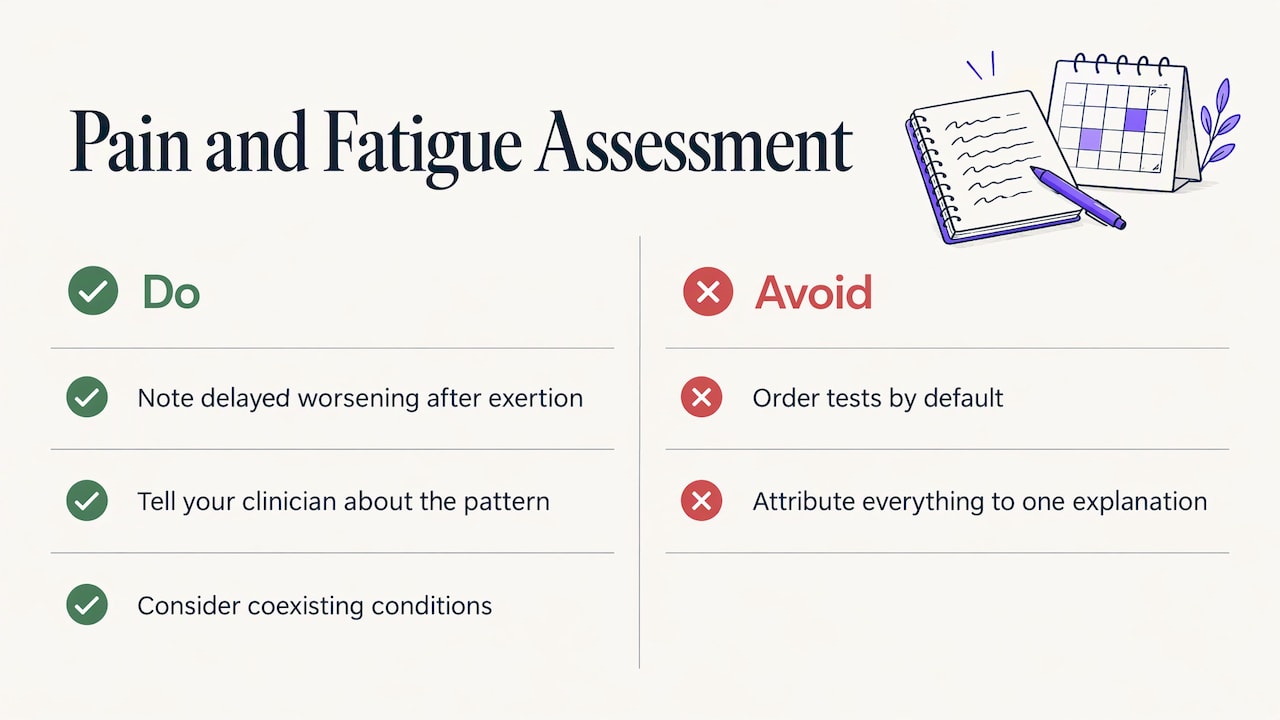
Pain and exhaustion often travel together, and several conditions can produce both. The Royal College of Physicians recommends that clinicians consider differential or coexisting conditions such as hypothyroidism, rheumatic and neurological diseases, medication-induced pain, sleep disorders, chronic fatigue syndrome and depression, and that further tests should follow clinical suspicion rather than being ordered by default.
One detail helps separate fatigue types. A 2024 German-Austrian-Swiss consensus statement highlights post-exertional malaise, a delayed worsening of symptoms after exertion, as characteristic of ME/CFS and as a way to tell it from the tiredness seen in depression or burnout. The same statement cautions that overlapping symptoms call for careful consideration rather than pinning everything on one explanation.
The practical lesson: note whether exertion makes you worse a day or two later, and tell your clinician. It points the workup in a different direction.
Where the FM1 Test fits
When the standard workup has not explained your pain and fatigue, the question becomes whether the immune system is involved. The FM1 Test was built for that question. It is a blood test that uses DNA science to identify immune system changes related to fibromyalgia, chronic pain and fatigue, and it looks for specific DNA genomic signatures in positive patients.
What that means for you:
- A simple process. The test requires a quick blood draw at a local facility.
- A fast answer. Results are available within about a week.
- Coverage. The test is covered by Medicare and insurance.
- A path forward. Positive respondents are offered access to a no-cost clinical trial.
For patients who have been told nothing is wrong, a result that points to a measurable biological signature can be the evidence that makes the next conversation with a physician different. For skeptics, including family members and clinicians, it is something to look at rather than a description to take on faith. If you want the full background on options in this area, see what diagnostic tests for fibromyalgia exist and what to ask, and objective pain measurement and what can prove chronic pain.
For healthcare providers
Providers can facilitate FM1 Test orders for patients with chronic pain, fatigue and related symptoms. The test fits alongside the history, examination and targeted labs you already use: it addresses the immune and genomic layer that routine panels do not. Because it is insurance and Medicare covered and needs only a blood draw, it adds little burden to the patient’s visit schedule. Questions on ordering are answered in the FM1 Test FAQ.
Chronic pain or fibromyalgia?
The two overlap. Chronic pain is the broad category; fibromyalgia is one condition that produces widespread pain with fatigue and other symptoms. Sorting out which applies to you matters because it shapes treatment and what you can ask for. Our comparison of chronic pain versus fibromyalgia explains the differences in plain language.
If you are not sure who should lead your workup, start with which kind of doctor to see for chronic pain and fibromyalgia. A primary care physician can coordinate, and a rheumatologist, neurologist or pain specialist can take over as the picture clarifies.
Once you have answers
A diagnosis is a starting point. With one in hand, treatment options open up, from medication and physical therapy to newer approaches that researchers are studying, such as transcranial magnetic stimulation for fibromyalgia. Which of these suits you is a decision for you and your treating clinician.
If you have been living without a name for your pain, our guide on what to do when chronic pain has no diagnosis lays out the next moves. And for patients interested in research participation, how to find and join a chronic pain clinical trial covers the process.
Get tested with the FM1 Test
If your pain and fatigue are still unexplained, the FM1 Test gives you a concrete step: a quick blood draw at a local facility, results within about a week, and coverage through Medicare and insurance. If your result is positive, you are eligible for a no-cost clinical trial.

You can start your FM1 Test here or learn more on the FM1 Test home page.
Our perspective
For years, people with chronic pain and fatigue have been handed normal results and a shrug. We built the FM1 Test because that experience is not acceptable, and because the science now allows a better answer.
A symptom report matters, and it should always be believed. But belief is easier to sustain, for patients and for the people around them, when there is also something measurable. The FM1 Test identifies DNA genomic signatures that are designed to reflect immune system changes related to fibromyalgia, chronic pain and fatigue, and we position it as evidence that fibromyalgia is a legitimate medical condition, not just a collection of complaints.
We also kept the test simple. A quick blood draw, a local facility, results in about a week, and coverage by Medicare and insurance. Patients should not have to travel, wait months or fight over cost to find out what is happening in their bodies. And for those whose results are positive, a no-cost clinical trial means the answer can lead somewhere.
Our advice is to pair the test with a good conversation: bring your timeline, share your result with your physician, and keep building the full picture together.
the author
FAQ
Is there one test that diagnoses chronic pain?
No. The NIH says no single blood test, scan or device completely measures pain in another person. Clinicians combine your history, examination and selected tests to find the causes behind it. Your own description of the pain is a central part of that process.
What tests might a doctor order for chronic pain?
Common choices include blood tests for inflammation, hormones, nutrition and autoimmune disease, imaging such as X-ray or MRI, and nerve studies such as EMG. Which ones you get depends on what your history and exam suggest. If the results are normal and your pain and fatigue persist, the FM1 Test is a blood test designed to look at immune system changes related to fibromyalgia.
How long does the FM1 Test take, and is it covered?
The test requires a quick blood draw at a local facility, and results are available within about a week. It is covered by Medicare and insurance. For specifics on your plan, use the FM1 Test FAQ.
What happens if my FM1 Test is positive?
A positive result means DNA genomic signatures related to fibromyalgia were identified in your sample, and you are offered access to a no-cost clinical trial. Share the result with your physician so it can inform your treatment plan.
What should I bring to a chronic pain appointment?
Bring a one-page timeline of when the pain started, where it is, what changes it and what else comes with it, plus a list of medications and past test results. The University of Michigan guide lists these same elements in an initial evaluation of chronic pain.
Sources
- Pain | Health, National Institutes of Health
- Pain | National Institute of Neurological Disorders and Stroke
- Chronic Pain | HealthLink BC
- Pain Management, NCBI Bookshelf
- Table 3, Initial Evaluation of Chronic Pain
- The diagnosis of fibromyalgia syndrome, Royal College of Physicians
- D-A-CH ME/CFS consensus statement, 2024