Fibromyalgia Test Turnaround Time: Results and Diagnosis

Turnaround time for a fibromyalgia test means two different clocks. The first is how long a lab takes to return a result after your blood draw. The second is how long it takes to get from your first symptoms to a diagnosis. The FM1® Test is built for the first clock: it needs a quick blood draw, and our results are available within about a week. The second clock is the one that wears patients down, and studies put it in years. This guide explains both so you can plan the shortest path to an answer.
TL;DR
- Most routine blood tests come back in 1 to 2 days, though some take longer.
- The FM1 Test needs a simple blood draw at a local facility, and results are available within about a week.
- The slow part is usually the path to diagnosis: research puts the average at several years, depending on the study and region.
- Bringing a symptom timeline, past lab results and a clear question to your clinician can shorten that path.
- The FM1 Test is Medicare- and insurance-covered, and positive patients are offered a no-cost clinical trial.
Table of Contents
- The two clocks behind “turnaround time”
- How long blood tests usually take
- The FM1 Test: what the timeline looks like
- Why diagnosis itself often takes years
- How to shorten your own timeline
- What happens after the result
- Our perspective
- Start your FM1 Test
- FAQ
- Sources
The two clocks behind “turnaround time”
People who search for this phrase usually want one of two answers.
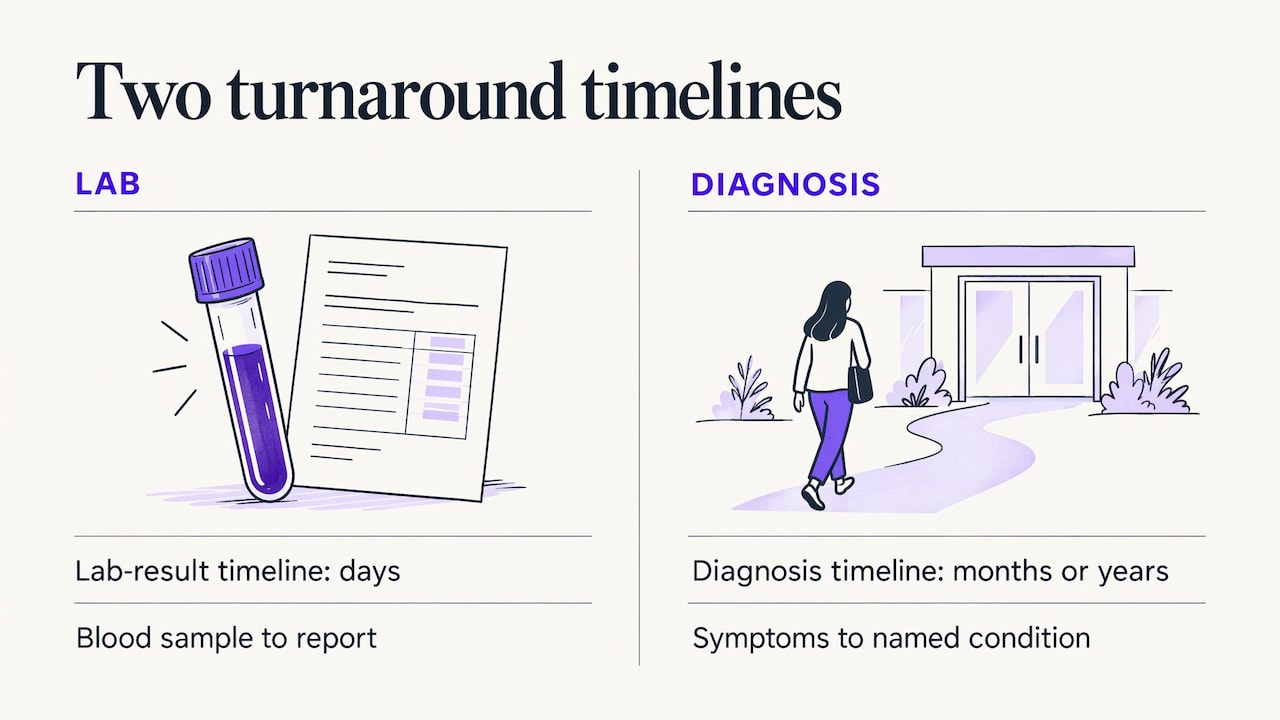
Clock one: the lab. You give a blood sample, a laboratory analyzes it, and a report goes to you or your provider. This is measured in days.
Clock two: the diagnosis. You first notice widespread pain, exhaustion and brain fog. You see one clinician, then another. Tests are ordered, other conditions are considered, and eventually someone names the problem. This is measured in months or years.
A fast lab result only helps if it feeds into a fast decision. That is why the rest of this article covers both, and why we built the FM1 Test around giving patients and their providers objective information early, rather than at the end of a long process of elimination.
How long blood tests usually take
Blood work is the most common first step when someone has unexplained pain and fatigue. According to Australia’s national health information service, results for most common blood tests are ready in 1 to 2 days, and some tests take longer to process. In the US, the exact timing depends on the lab, how often it runs a given assay, and whether your sample is shipped to a central facility.
For fibromyalgia-like symptoms, clinicians often order a short panel. The American Family Physician review of fibromyalgia diagnosis says a complete blood count, a comprehensive metabolic panel and a thyroid-stimulating hormone (TSH) test can be considered. These look at blood cells, organ function and thyroid activity, which helps your clinician see whether something else could explain how you feel. They are typically quick, common tests.
Specialized tests are different. Autoimmune and other specialty assays are often run in batches on certain days or sent out to reference labs, so a result can take several days rather than one. If your clinician orders more than one test, ask when you can expect each result, because your appointment will be set by the slowest one.
The FM1 Test: what the timeline looks like
The FM1 Test is a DNA-based blood test that looks for immune system changes related to fibromyalgia, chronic pain and fatigue. In practical terms, the timeline is short:
- Order. You or your healthcare provider starts the order. You can begin on our get started page.
- Blood draw. The test requires only a quick blood draw, available at local facilities.
- Results. Results are available within about a week.
- Next step. If your result is positive, you are eligible for a no-cost clinical trial.
The test looks for specific DNA genomic signatures that our science associates with fibromyalgia. For a patient who has spent months or years wondering whether the pain is real, an objective result in about a week changes the conversation with family, employers and other clinicians. If you want to know how to read a report once it arrives, our guide to fibromyalgia test results walks through what they show and mean.
What can slow the week down
A few practical things affect any lab timeline, including ours:
- Where you draw. Collection at a local facility is quick, but shipping time starts after the draw.
- Paperwork. An incomplete order or missing insurance information can delay the draw rather than the analysis.
- Follow-up. The result only helps once your provider reviews it with you, so book that visit when you book the draw.
Why diagnosis itself often takes years
The lab is rarely the bottleneck. Studies of the full diagnostic journey show long delays:
| Study | What it found |
|---|---|
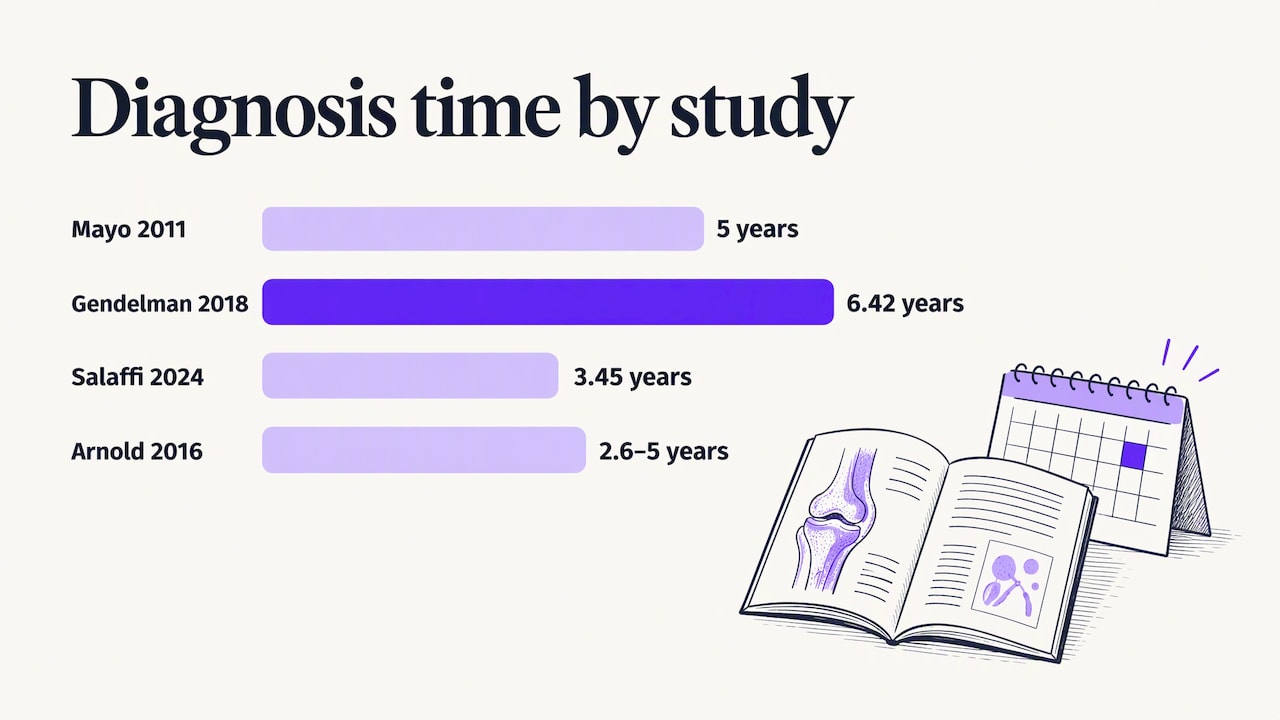
| Mayo Clinic Proceedings review, 2011 | Diagnosis time averages 5 years, and as many as 3 in 4 people with fibromyalgia remain undiagnosed |
| Gendelman et al., 2018 | Mean time from first complaints to diagnosis was 6.42 years among 2,369 eligible patients |
| Salaffi et al., 2024 (Italian registry) | Mean time to diagnosis was 3.45 years among 616 patients, and longer delay was linked to worse severity scores |
| Arnold et al., 2016 | Time to diagnosis ranged from 2.6 to 5 years across the USA, Latin America and Europe |
The numbers differ because the studies measured different groups and started the clock at different points. The pattern is the same in all of them: months of uncertainty turn into years.
Several things drive that delay. Pain moves around and varies from day to day. Fatigue, sleep problems and brain fog overlap with many other conditions. Patients are often passed between clinicians. The Arnold review cites a study in which patients saw an average of 3.7 physicians before diagnosis. Each handoff restarts the story and sometimes restarts testing.
The delay has a cost. The Italian registry linked a longer wait to worse severity scores, which is one more reason to move toward an answer rather than wait to see whether symptoms settle.
How to shorten your own timeline
You cannot control how busy a clinic is, but you can control how prepared you are. These steps are built around what slows people down.
1. Write a symptom timeline before your visit
Note when the pain started, where it is (the most widely used criteria look at pain across body regions for at least three months), how tired you are, how you sleep, and what makes it better or worse. The American Family Physician review explains that the 2016 American College of Rheumatology criteria require generalized pain in at least 4 of 5 body regions for at least 3 months, along with minimum scores on a pain index and a symptom severity scale. A written timeline gives your clinician what they need to apply those criteria in one visit instead of three.
2. Gather the labs you already have
Routine labs are generally only repeated if they have not been done recently. The Mayo Clinic Proceedings review notes that routine labs such as inflammation markers, a blood count, a metabolic panel and thyroid function are obtained only if not done in the past 6 to 12 months. Bring recent results, or ask your previous clinic to send them. That alone can save a week or more of waiting.
3. Ask for an objective test early
Do not wait for every other possibility to be exhausted. The Arnold review says fibromyalgia is not a diagnosis of exclusion to be used as a last resort: your physician can assess history and examination against criteria and begin treatment right away. The Canadian guidelines go further, noting that early diagnosis avoids lengthy, costly and unnecessary investigations that prolong uncertainty. The FM1 Test fits this approach because it gives you an objective result from one blood draw, in about a week. Our page on when to seek a fibromyalgia diagnosis explains how to decide that it is time.
4. Check coverage before you draw
Insurance questions are a common source of delay. The FM1 Test is Medicare- and insurance-covered. Our guides on Medicare coverage for fibromyalgia testing and on what you pay and what insurance covers cover the details, so you can settle billing before the draw rather than after.
5. Book the results visit at the same time
A result in your inbox is not an answer until someone interprets it with you. Schedule the follow-up with your provider for the week after the draw. If your result is positive, you can also discuss the no-cost clinical trial we offer.
6. Start looking at care while you wait
Waiting for a result does not mean waiting to take care of yourself. Reading about fibromyalgia treatment options while you wait helps you arrive at your results visit with questions ready.
What happens after the result
A diagnosis is the start of a plan. For people who have waited years, a clear answer often brings relief on its own, because the pain finally has a name backed by evidence. For providers, an objective result supports documentation, referrals and treatment decisions. Our overview of how doctors diagnose fibromyalgia shows how a test result fits alongside the clinical criteria.
While you wait, certain symptoms need prompt medical attention rather than a test timeline. If you have a fever, unexplained weight loss, new weakness or numbness, joint swelling, or sudden severe pain, contact your doctor or urgent care promptly.
Our perspective
Most of the frustration we hear about is not the days a lab takes. It is the years before anyone looks for a cause. Patients with chronic pain and fatigue are often told to wait, to try again next year, or that nothing shows up.
We built the FM1 Test to change that. It uses DNA science to identify immune system changes related to fibromyalgia, chronic pain and fatigue, and it looks for specific DNA genomic signatures in positive patients. We designed it to give people objective, scientifically backed evidence that what they feel is a legitimate medical condition.
The process is deliberately simple: a quick blood draw at a local facility, results in about a week, and coverage through Medicare and insurance. For patients who test positive, we offer a no-cost clinical trial. That matters to us because a result should lead somewhere.
If you have been waiting for an answer, the shortest route is to put an objective result in front of your clinician and decide the next step together.
the author
Start your FM1 Test
If you want an objective answer without months of waiting, the FM1 Test is a DNA-based blood test that takes one quick blood draw and returns results within about a week. It is covered by Medicare and insurance, and positive patients are eligible for a no-cost clinical trial.

You can start your FM1 Test here, or read the FM1 Test FAQ first. For an overview of the test itself, visit fm1test.com.
FAQ
How long does the FM1 Test take to return results?
Results are available within about a week of your blood draw. The draw itself is quick and happens at a local facility. Your provider can review the result with you at a follow-up visit.
How long do routine blood tests for fibromyalgia symptoms take?
Results for most common blood tests are available within 1 to 2 days, though some tests take longer. Clinicians often use a blood count, a metabolic panel and a thyroid test to look at other possible causes of your symptoms.
Why does getting a fibromyalgia diagnosis take so long?
Symptoms such as pain, fatigue and brain fog overlap with many other conditions, and pain varies from day to day. Studies measure the average wait at several years, often with several clinicians involved along the way. Arriving with a symptom timeline and past lab results helps shorten it.
Do I need a doctor’s order for the FM1 Test?
Healthcare providers may facilitate test orders, and you can begin the process on our get started page. Coverage depends on your plan, so check our Medicare coverage guide or the FAQ for details.
Sources
- Healthdirect: Guide to blood testing
- American Family Physician: Fibromyalgia: Diagnosis and Management, 2023
- Clauw, Improving the Recognition and Diagnosis of Fibromyalgia, Mayo Clinic Proceedings, 2011
- Gendelman et al., Time to diagnosis of fibromyalgia, 2018
- Salaffi et al., Delay in fibromyalgia diagnosis, 2024
- Arnold et al., Fibromyalgia: management strategies for primary care, 2016
- Canadian Guidelines for the diagnosis and management of fibromyalgia, 2012
- Effective Fibromyalgia Treatments: Traditional & Natural