Unexplained Pain Tests: What Doctors Order and What’s Next

When pain or fatigue has no obvious cause, the usual path is a careful history, a physical exam and a set of routine blood tests that rule out look-alike conditions. If those come back normal and the pain stays, the next question is whether anything can show what is driving it. The FM1® Test is a DNA-based blood test designed to identify immune system changes linked to fibromyalgia, chronic pain and fatigue, so a normal workup does not have to end with no answers.
This guide walks through what clinicians typically check first, which blood tests are common and what they can and cannot tell you, and how to use the results in your next appointment.
TL;DR
- Workups for unexplained pain usually begin with a detailed history, a physical exam and basic blood tests that screen for conditions with similar symptoms.
- Routine panels (blood count, inflammation markers, thyroid, liver and muscle enzymes) are meant to find other causes. A normal result is useful, but it does not explain your pain.
- Repeating the same tests rarely adds information. A targeted next step does.
- The FM1 Test is a blood draw that looks for DNA genomic signatures tied to immune changes in fibromyalgia. Our results arrive within about a week, and the test is covered by Medicare and insurance.
- Positive respondents are eligible for a no-cost clinical trial.
Table of Contents
- What clinicians look at first
- Blood tests commonly used for unexplained pain
- What your results can and cannot tell you
- When tests keep coming back normal
- Where the FM1 Test fits
- Our perspective
- Ready to test
- FAQ
- Sources
What clinicians look at first
Before ordering anything, a good clinician listens. A review of medically unexplained symptoms describes the starting point as a thorough history: which symptom is worst, what triggers it, what else comes with it, how it affects daily life and sleep, which medications you take, and your medical, psychiatric and family history. A physical exam (heart, lungs, abdomen, nervous system) and baseline observations follow.
The NIH’s overview of pain says that after reviewing your pain history and medical concerns, providers may add laboratory tests, imaging, electrodiagnostic procedures, skin biopsy or quantitative sensory testing (used when small-nerve damage is suspected), and psychological and functional assessments.
Bring this to the first visit
A clear picture speeds everything up. Before you go, write down:
- Where it hurts, and whether the pain moves or is widespread
- When it started and how long it has lasted
- What makes it better or worse
- Sleep quality, fatigue, brain fog, stomach or bowel symptoms
- Every medication and supplement you take
Medications matter more than people expect. A 2026 primary care framework on fatigue recommends a thorough medication review, noting that sedatives, antidepressants, antihypertensives and antihistamines may contribute to fatigue. The same framework suggests validated screening questionnaires such as PHQ-9 for depression, GAD-7 for anxiety and STOP-BANG for sleep apnea risk.
Symptoms that need prompt attention
Some features call for urgent investigation or referral rather than a routine workup. The same 2026 framework lists unintentional weight loss, persistent or unexplained fever, night sweats, swollen lymph nodes, unexplained bleeding or bruising, unexplained anemia, chest pain or palpitations, breathlessness on exertion, severe sleep disturbance and neurological changes such as focal weakness or altered sensation. If you have any of these, see your doctor promptly.
Blood tests commonly used for unexplained pain
Most first-round blood tests exist to catch conditions that can imitate or overlap with chronic widespread pain. The lists differ a little between guidelines, but they overlap heavily.
| Test | What it screens for | Source |
|---|---|---|
| Complete blood count (CBC) | Anemia and other blood abnormalities | AFP, 2023 |
| C-reactive protein (CRP) and ESR | General inflammation | Peer-reviewed review, 2015 |
| TSH | Underactive thyroid | France’s HAS, 2025 |
| CPK (creatine phosphokinase) | Muscle disease or injury | HAS, 2025 |
| Transaminases / liver tests | Liver problems | HAS, 2025 |
| Comprehensive metabolic panel, glucose or HbA1c, creatinine | Kidney, liver and blood sugar issues | AFP, 2023; 2015 review |
| Vitamin D | Deficiency | 2015 review |
France’s national health authority recommends CBC, CRP, TSH, CPK and transaminases as the minimum, with further tests guided by signs, symptoms and clinical judgment. The 2015 review adds fasting glucose or HbA1c, creatinine, vitamin D, ESR and CRP.
If you want a plain-English primer on how markers in blood are read, see what a blood marker test is.
Tests that are not routine
The American Family Physician guidance says antinuclear antibody and rheumatoid factor tests are not recommended unless there are features pointing to a rheumatologic condition, because false positives are common. That is why your doctor may not order them on the first pass, and why they are added when your symptoms point that way (for example, swollen joints or a rash).
Conditions the workup is trying to exclude
HAS lists conditions that can mimic or coexist with fibromyalgia: rheumatoid arthritis, ankylosing spondylitis, lupus, Sjögren’s disease, myositis, hypothyroidism, myeloma, porphyria, Fabry disease, Ehlers-Danlos syndrome, celiac disease, Lyme disease, post-COVID-19 symptoms and chronic fatigue syndrome. Finding one of these is good news in the sense that it gives you a treatable target.
What your results can and cannot tell you
A normal CBC, CRP, thyroid and liver panel tells you that a set of common causes is unlikely. It does not tell you your pain is not real, and it does not mean nothing is going on. The ME Association’s guide to baseline blood tests notes that normal results usually indicate no concern, slight elevations may be retested, and significant elevations need further investigation.
If results are abnormal, that usually leads to a specific referral. If they are normal and you still hurt, the question changes from “which common disease is this?” to “what pattern fits my symptoms?” For widespread pain with fatigue, sleep problems and brain fog, that pattern is often fibromyalgia.
How doctors reach a fibromyalgia diagnosis
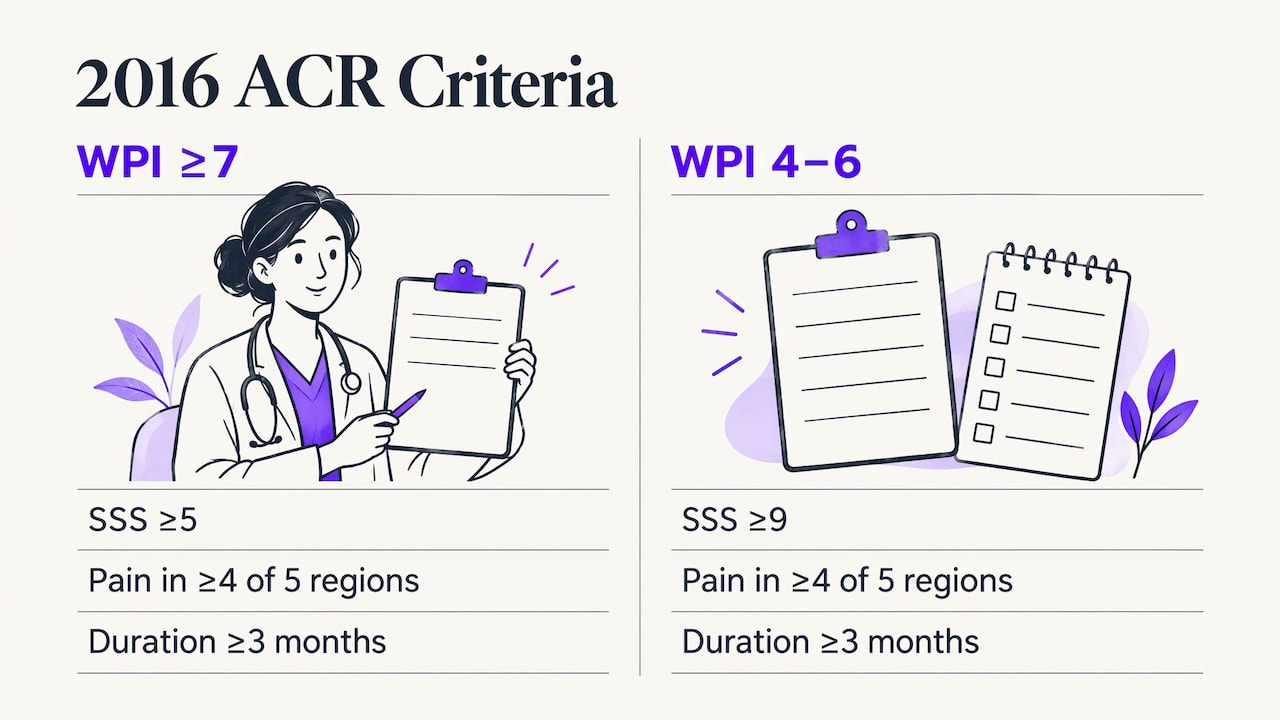
Clinicians use the 2016 American College of Rheumatology criteria. As summarized in a 2025 review, they combine a Widespread Pain Index (WPI) with a Symptom Severity Score (SSS). The diagnosis fits when the WPI is 7 or higher with an SSS of 5 or higher, or the WPI is 4 to 6 with an SSS of 9 or higher. Pain must be generalized, present in at least 4 of 5 body regions, and have lasted at least 3 months.
France’s HAS also recommends considering fibromyalgia from the outset when pain is diffuse, the exam is normal and no disease or medication explains the pain. It suggests the six-item FIRST questionnaire as a screening aid: five or more positive answers strongly suggest fibromyalgia, with the clinician’s judgment remaining primary.
This is where many patients get stuck. The questionnaire and exam describe your symptoms, but they do not show what is happening inside your immune system. That is the gap our test was built for.
When tests keep coming back normal
More of the same testing is not the answer. The ACOEM chronic pain guideline (effective December 19, 2024) supports judicious testing at the first exam to look for a specific, treatable cause, and does not support repeated testing without a targeted reason. HAS likewise advises against piling on extra tests when results are hard to interpret and recommends referral to a specialist such as a rheumatologist, neurologist, internal medicine physician, psychiatrist or pain specialist.
A practical plan for this stage:
- Ask your doctor which conditions the normal results have ruled out, and which have not been checked.
- Ask whether your symptoms meet the criteria above, and what the next targeted step would be.
- Keep a symptom and sleep log for two to four weeks so the specialist sees the pattern.
- Request a referral if one has not been offered.
- Ask about a test that looks at the biology of fibromyalgia directly.
Where the FM1 Test fits
The FM1 Test is a blood test that uses DNA science to identify immune system changes related to fibromyalgia, chronic pain and fatigue. We designed it to identify specific DNA genomic signatures in positive patients, signatures that are not found in other disorders or in healthy people. For someone whose routine labs were normal, a result of this kind is evidence tied to the condition itself, not just the absence of other findings.
What the process looks like:
- A quick blood draw at a local facility.
- Results within about a week.
- Coverage through Medicare and insurance.
- For positive respondents, eligibility for a no-cost clinical trial.
For a patient, a clear result can support the conversation with family, employers and insurers, and with doctors who have been unsure. For clinicians, it adds an objective data point to the history, exam and criteria they already use. You can read how results are interpreted in our guide to fibromyalgia test results, see how doctors diagnose fibromyalgia, or check whether a fibromyalgia test is right for you.
Our perspective
Every week, people describe the same experience: a stack of normal results and a sense that nobody believes them. We built the FM1 Test around a simple idea, that chronic pain and fatigue deserve objective evidence.
Routine labs do an important job. They rule out thyroid disease, anemia, inflammation and other conditions, and everyone with unexplained pain should have that done. We see the FM1 Test as the next step after that groundwork, not a replacement for a good clinician.
Our test looks for DNA genomic signatures of immune system changes in fibromyalgia, chronic pain and fatigue. A positive result gives patients something concrete to take back to their doctor, and it opens the door to a no-cost clinical trial. For providers, it is a quick blood draw with results in about a week, covered by Medicare and insurance.
If you have been told that everything looks normal while you live with pain every day, you deserve a test that looks at the biology behind it.
the author
Ready to test
If your routine workup has not explained your pain or fatigue, the FM1 Test gives you a way to look at the immune system changes linked to fibromyalgia, with a simple blood draw, results in about a week, and Medicare and insurance coverage.

You can start your FM1 Test online, or read the FM1 Test FAQ for questions about coverage and the process.
FAQ
What tests are used for body pain with no clear cause?
Doctors usually start with a history and physical exam, then basic blood work such as a blood count, inflammation markers, thyroid and liver tests. Depending on symptoms, they may add imaging, nerve studies or specialist referral, as outlined by the NIH. The FM1 Test is a further option that looks at DNA signatures of immune changes linked to fibromyalgia.
Can normal blood tests still mean something is wrong?
Yes. Routine panels are designed to find specific conditions such as anemia, thyroid disease or inflammatory disease. If they are normal, those causes are less likely, but ongoing pain still deserves evaluation, such as a review against the fibromyalgia criteria and a conversation about targeted testing.
How long does the FM1 Test take?
It requires a quick blood draw, and results are available within about a week. Our FAQ covers the process step by step.
Is the FM1 Test covered by insurance?
The FM1 Test is covered by Medicare and by insurance. We do not publish a price, so ask us about your coverage when you start your order.
What happens if my FM1 Test is positive?
Positive respondents are eligible for a no-cost clinical trial. Share the result with your doctor so it can inform your treatment plan alongside your history and symptoms.
Sources
- Medically unexplained symptoms: assessment and management
- Approach to Fatigue in Primary Care
- NIH: Pain
- Fibromyalgia: Diagnosis and Management, AFP 2023
- Central Sensitization Syndrome and the Initial Evaluation of a Patient with Fibromyalgia
- HAS: Fibromyalgia in adults, 2025 guideline
- Fibromyalgia: Understanding, Diagnosis and Modern Approaches
- ME Association: Blood tests explained
- ACOEM Chronic Pain guideline
- What is a blood marker test?